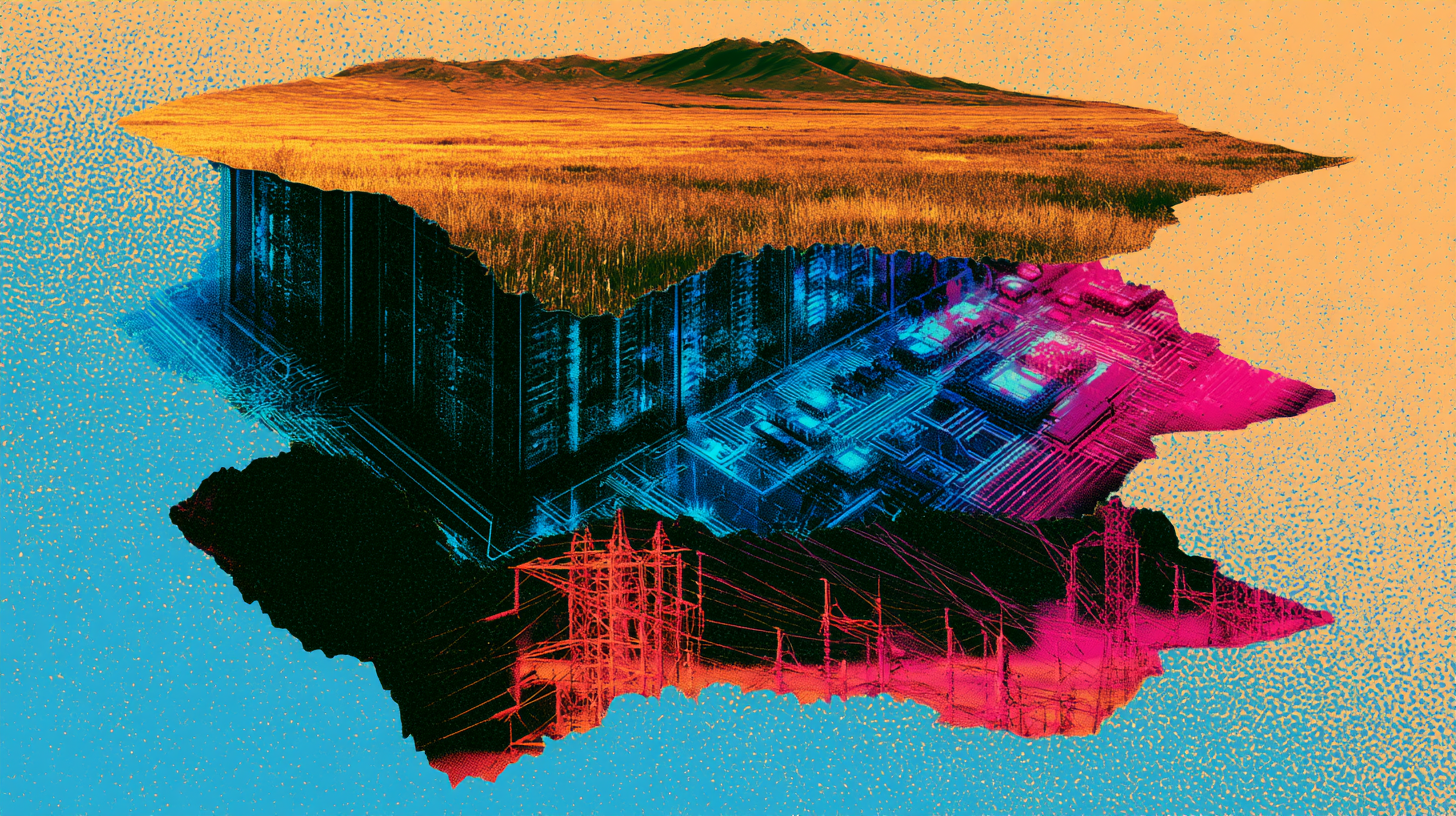
Every machine age has a layer nobody wants to do. The railroads had the coal. The internet had the fiber. The AI age has the power plants — and the power plants are beginning to land where the ground is coldest.
Two things happened in 2026.
In the places where AI is already big, the buildout ran into a wall that is not a chip. It is a kilowatt. Ireland, a country that hosts the data centers of half the cloud, watched those buildings climb past a quarter of its national electricity demand. The scarcity that now decides where the next machine gets built is not design talent or capital — it is power, and cold air to cool it.
And in Kazakhstan — a nation of twenty million on the Eurasian steppe, with a coal basin and winters that stay below minus fifteen — the government signed a $10 billion agreement with Nvidia to build something called a "Data Center Valley." A month later, the highest leaders of Kazakhstan and China held talks on artificial intelligence in Shanghai and signed more than seventy commercial agreements worth over $15 billion, most of them pointed at AI and the digital economy.
That is the whole story in one paragraph: the machine age has a new bottleneck, and a new country is quietly moving to fill it.
Korea rode the first layer. It designed the chips — the memory, the logic, the wafers — and became rich on the highest-value slice of the stack.
Malaysia rode the second layer. It did not design anything. It assembled, packaged, and tested what others designed, and its economy grew six percent in a quarter on the back of chip plants and data centers it never invented. The lesson from that story, which we covered in an earlier AI Special Feature, was simple: you don't need to build the AI — you need to be the factory.
Kazakhstan is reaching for the third layer. It does not design the chips. It does not assemble them. It does the thing the age is now shortest on: it sells the power and the cold.
The wave does not jump over countries. It moves down the supply chain toward whatever input has become scarce, and the input that is scarce now is energy. That is not a theory about Kazakhstan. It is a list of names.
The $10 billion has names.
Firebird AI, a U.S. startup backed by Nvidia, is the operating partner. Kazakhtelecom, the state operator, is the local counterparty — it is putting in the first billion of its own money. The site is Ekibastuz, a coal basin in the northeast, chosen the way a mill is built at a river: the fuel is already there. The plan is 125 megawatts first, scaling toward a gigawatt, with a target of as many as a hundred thousand Nvidia chips. The first fifty megawatts are meant to switch on by June 2027.
Then the layer thickens. Two Singaporean firms — GK Hyperscale and SuperX AI — are planning sites measured in hundreds of megawatts across the northern regions. Astana is building Alem.AI, its international AI centre. And from the other direction comes China: Hengtong Group signed a framework with Kazakhtelecom on the Data Center Valley, Huawei signed a strategic cooperation deal, Qi An Xin a cybersecurity memorandum, and 01.AI — Kai-Fu Lee's firm — a joint venture for sovereign AI called Q.AI.
Read that list again. A U.S. chip giant. A U.S. startup. The state telecom of Kazakhstan. Two Singaporean infrastructure funds. A Chinese computing firm. All of them arriving, in the same twelve months, to plug into the same grid.
Something about this place has become, all at once, the lowest point on the map.
Why Kazakhstan? The answer is three physical facts, none of which required a marketing campaign.
The coal. Ekibastuz is one of the largest coal basins in the world. The Kazakh government's own phrase for what it is doing is not subtle: turning coal into digital exports. Baseload power here is cheap in a way it is not in Dublin or Frankfurt or Northern Virginia.
The cold. A data center spends roughly a third of its energy on cooling. Kazakhstan's north sits below minus fifteen degrees for months of the year, so the cooling is free — the same arithmetic that made Sweden and Iceland into data-center hubs, applied to cheaper land and cheaper power.
The neutral ground. The country sits between two worlds and is aligned to neither. In an era when both the U.S. and China are looking for compute they can reach without touching the other, a non-aligned steppe is a feature, not a bug.
And there is precedent, if you know where to look. In 2021, when China banned cryptocurrency mining, the miners packed up and moved to Kazakhstan, which briefly became the world's second-largest Bitcoin miner. That was the dry run. It proved the power was there and could be bought. Now the same power is being re-pointed from coins to AI models.
This is where the metaphor matters, because the temptation is to describe all of this as someone's plan. It is not.
In the previous AI Special Feature, we wrote about 势 — the Go player's word for momentum that emerges from the arrangement of stones, a force no single stone intended — and about water, which takes the shape of the ground it meets and flows toward the low places. No one directs the AI buildout. Nvidia needs power and a place to put it. China needs compute it can reach. Singaporean funds need returns. Kazakhstan needs an economy after oil. Each of these is a rational move by itself; none of them, standing alone, planned a data center valley on the steppe.
That is what a wave looks like from inside. It is just water finding the low ground.
None of this means it is certain. It is not.
The $10 billion is a framework, not a cheque. The first phase is closer to five, and the fine print splits signed agreements from ultimate ambition — the kind of distinction that has let many a "regional hub" announcement stall quietly between the signing and the building. The real test is concrete and dated: fifty megawatts by June 2027, and whether it beats the twelve megawatts Uzbekistan is switching on this winter next door.
And there is a shadow over the whole thing that this piece will only name and set aside: advanced chips sitting in a neutral steppe are a geopolitical object, and they will be treated as one. That is not this story. This story is simpler.
Korea designed it. Malaysia assembled it. Kazakhstan powers it. The machine age keeps finding its physical layer — and the next layer it found is the coldest one.
Content is for informational and analytical purposes only — not investment, financial, or legal advice.